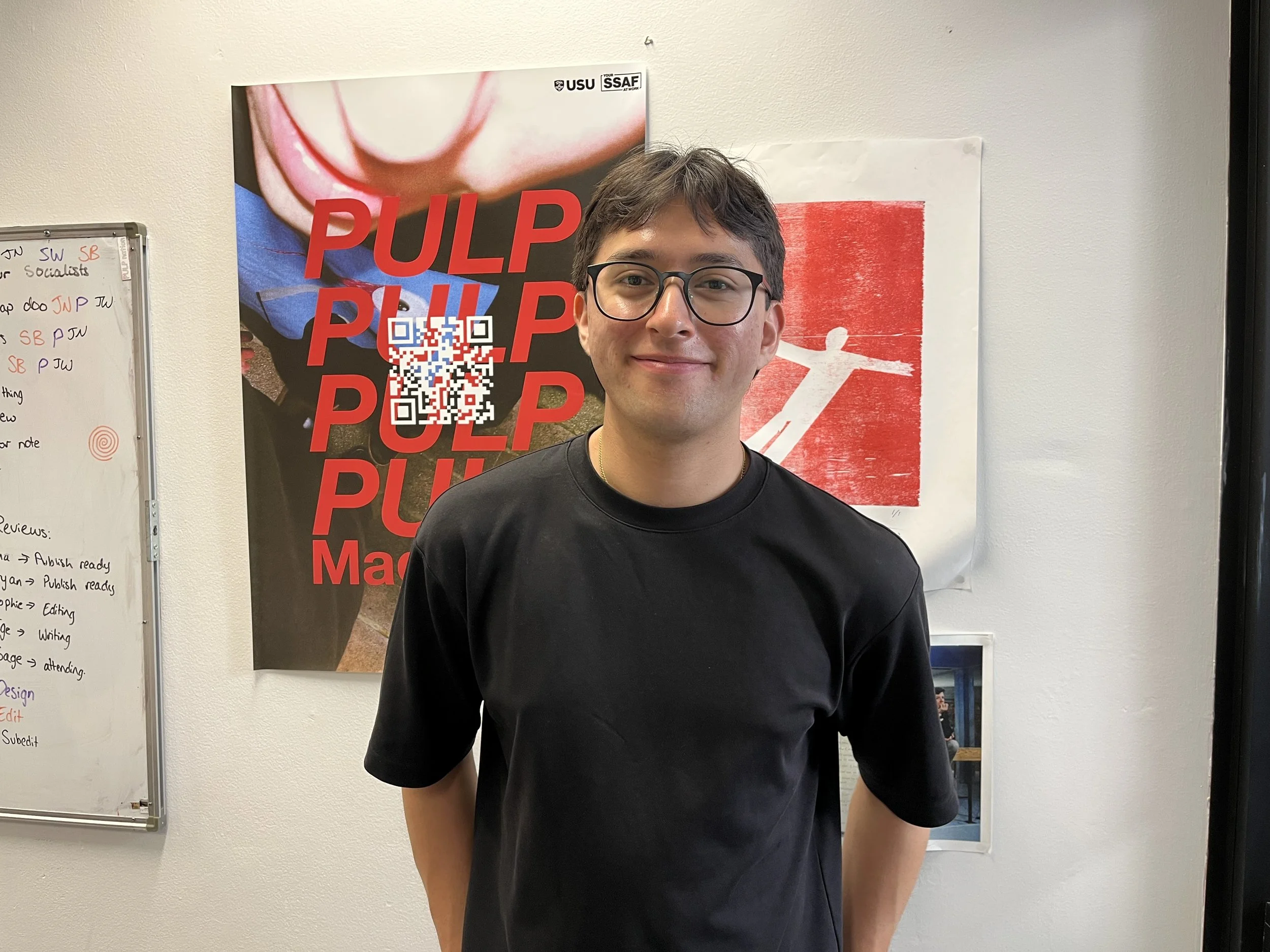
The Artist Currently Known As: Jayden Nguyen
Jayden is a writer and an editor of PULP, Usyd’s arts and culture magazine.
What are you studying? Political Economy and English.
How are you finding it? Good. About a year ago, I was convinced that I cared about English more than political economy. My interests in both subjects came from my own upbringing — my mum is Vietnamese and my dad is Nicaraguan. A lot of what I’ve done in Australia, as a proper first-born Australian, my grandparents can’t understand beyond translation. They can’t read it for themselves. My grandma on my dad’s side speaks Spanish and then Vietnamese on my mum’s side. I grew up in South-West Sydney, which is much more ethnically diverse and socioeconomically disadvantaged. I had this idea that being a human rights lawyer would solve all the world’s problems, and then I was disillusioned because I realised Sydney Law School is just full of elites.
It was kind of ironic for me to see that a lot of Marxists in the social sciences dedicate their time to debates about what Marx truly said. [In political economy] I learn more essential things about what causes inflation, what causes wealth inequality. I can now answer these fundamental economic questions and tie it to real political questions. And I feel like that major allows me the most space to provide an alternative for reality today.
What you’ve written for Honi Soit and PULP touches a lot on political theory in some form or another. Something I found is that you keep exploring this tension between theory and practice, which is something that is ever-present for us, because we’re students and we’re artists and we’re so entwined with this mega university complex which complicates both. How do you think about the two?
A lot of grassroots radical politics is inspired by Marxist political theory which calls for class consciousness and revolutions, which makes sense for restructuring a society completely anew. I think a lot of the time the ideas of praxis and moving things into the real world are actually limited if you think about voting or attendance at rallies as constituting political action. This is something that the Marxists of today really have to reckon with; we’re not in a state where to resolve human equality, people truly should be putting their lives on the line in order to resolve an issue that has become institutionalised at a really big scale. I think in terms of resolving political issues, a lot of it comes down to finance and money. Not necessarily body count.
You’re also responding to a blind spot which I think aggravates a lot of people, and me as well, where it’s only the bourgeoisie who use the word ‘bourgeoisie.’ Like, it’s such a limited sphere of understanding and language that gestures towards inclusion. No, it is. I think you got that very accurately. And that was my frustration with political theory, that a lot of it is so obsessed with these discursive things. Whereas when you confront issues of inequality today with, you know, the Reserve Bank should lower the cash rate because of these reasons, it will reduce income inequality in these ways. Instead of waiting for everyone to gain consciousness and then finally we’re ready for a revolution because everyone has read Karl Marx.
What are you consuming at the moment? What are you reading, watching, thinking about — anything. I’m a really big Lorde fan. My favourite album of the year is Virgin, which I must say, when it first came out, I didn’t love. [Blood Orange’s] new album Essex Honey is deep within my favourite album of the year, but socially and I guess being consistent with my fandom, Virgin is my favourite.
My boyfriend Sebastian listens to Sabrina Carpenter, which is so different to me. When I listen to Sabrina Carpenter, it feels like I’m consuming — you know when Netflix started making their own TV shows? I feel that way with Sabrina Carpenter.
You’re going be horrified to hear that I’ve been listening to the new Taylor Swift album. That’s not as bad. Really! Sabrina Carpenter is definitely more self-aware. And I think she tries to make more of a critique of modern feminism or heterosexuality. She’s at least trying to poke fun at something, which I appreciate more than Taylor, who is just dead serious.
But even when the album cover was coming out — when I first saw it, I was like, what are you doing! And I saw a comment that now I understand to be really catty, but at the time I was like, yes, this is what I think. And it said: your work is not sophisticated enough to make this critique. Now I look at that and I think, okay, you’re just assuming she’s an idiot. Sebastian at first, because he’s her biggest fan, was really excited about it and was like wow, this is such a cool album cover. And I was like, I don’t know. He was like, it’s clearly ironic. Can’t you see that it’s ironic? And I was like, I don’t know, is it ironic?
In the office, we make a lot of jokes about post-irony. There are different types of irony; there’s something that’s not ironic, it’s literal, and then above what’s literal is irony — it’s true meaning is beyond the literal — and then post-ironic, where meaning is blurred between the literal and the ironic to the point where both can equally make sense. I feel like her album cover is post-ironic. Like Brat. Because it’s also serious, it’s not just silly.
You’re about to put out your third issue as a PULP team. How have you been finding it? It’s been a really amazing experience. We had a big conflict about what the font should be for our new masthead. That was really funny. I love what you landed on. That era [of 2010-2014 Tumblr] is such a nostalgic moment for people of our age, so making the callback to that design style is a very interesting internet culture reference. Our team has really gravitated towards work that is critical, but also playful. And other pieces that we have coming out are a balance between the serious and the pleasurable.
Who are your favourite writers? My favourite poet of all time is Jazz Money, who is a First Nations contemporary poet. Her writing essentially gave me consciousness. I really love how in a lot of anti-colonial literature meaning is gate-kept, which dissatisfies the idea that English is a universal language of meaning. I also love Bluets by Maggie Nelson, another book which totally changed my life. I was so conscious of my surroundings and of my thoughts [after reading] that everything was turning into poetry in my mind. Notes of a Native Son by James Baldwin. It’s poetic, it’s confronting, and it’s so straightforward. I think my most controversial take is that I like Slavoj Žižek, who’s a Marxist philosopher and is very blunt with his opinions, but then his underlying argument overcomes that initial insult.
You spoke before about the language barrier that you have with some parts of your family, and it struck me as quite a literal decolonial strategy that you explore in your recent poem for PULP. Do you think that poetry is uniquely suited to some of the political aims we’ve been talking about? When I think of poetry against prose, poetry is the mode of experimentation in a lot of post-colonial writing. I think about it as also a visual artistic practice in a multi-sensory way; how it’s pronounced, or how there’s an inability to pronounce something when it’s in a different language. To communicate or to confront someone with that is an interesting political choice.
My specific poem: well, my mum and my family were in moments of scattered thoughts. My grandpa was ill and he was passing away, so everyone was all over the place. A lot of what I write or think about is in relation to my grandparents and the whole immigrant story. I wanted to write it in a way that had visual cues of vignettes and scattered thoughts, and also in a way which was confusing to read upon first glance. I wanted to formalistically communicate my experiences of navigating my own culture and my grandparents; coming to terms with the fact that I could never have a one-on-one deep discussion about what [my grandpa’s] childhood was like without my mum there to translate. In that sense, poetry became the form where I could express the most with the least amount of words. How can I communicate my grief in just a word and a symbol, and with negative space?
You can find Jayden at @jayden.a.ngyuen.