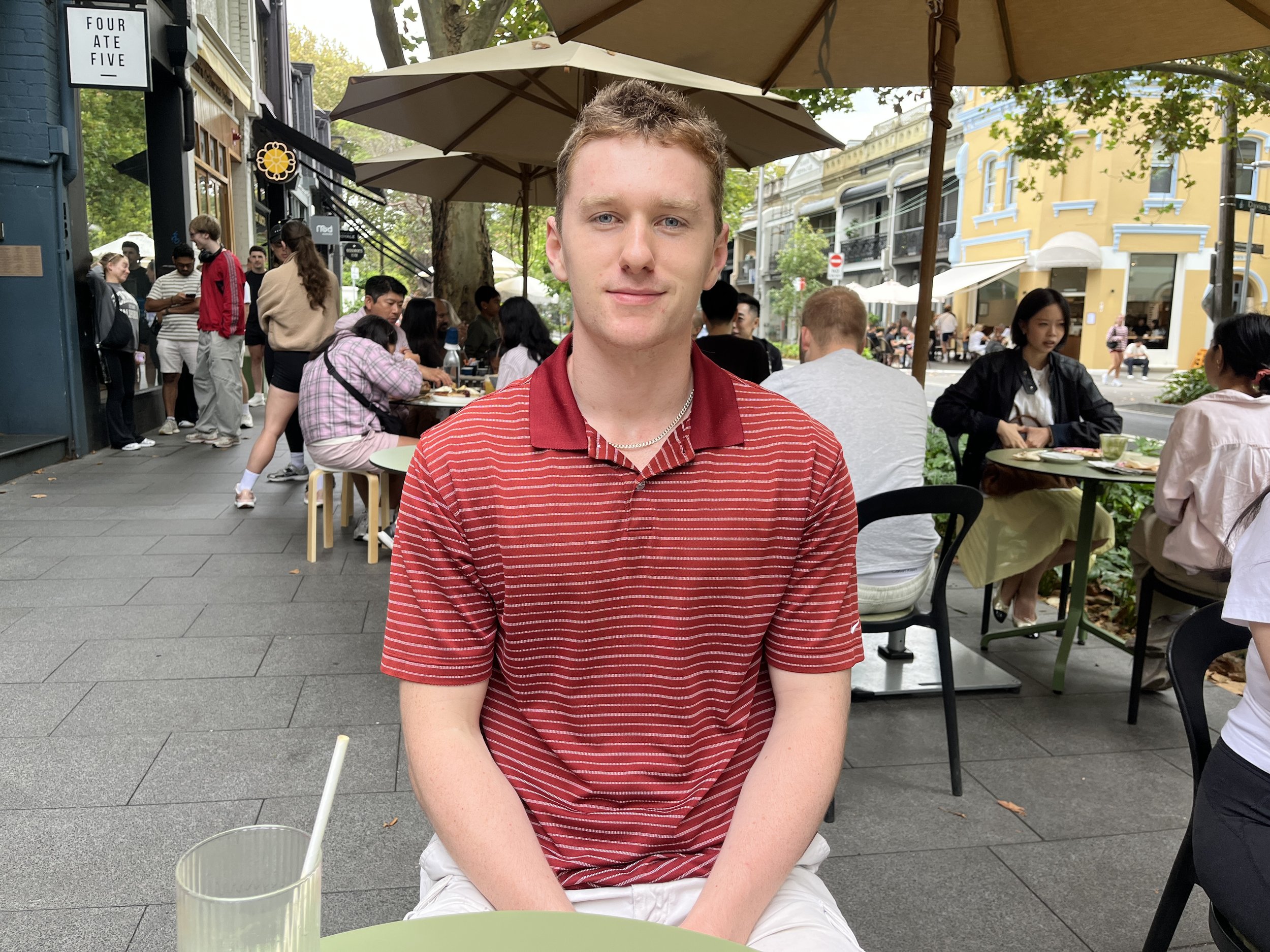
The Artist Currently Known As: Jamie Tooth
Jamie Tooth - AKA moteinmyeye - is a digital artist using TouchDesigner, based in Sydney/Eora.
What are you studying? I’m doing a Bachelor of Information Technology with a major in Cybersecurity at Macquarie University.
How are you finding it? It’s really good, I enjoy it. It’s quite technical, but I like it—but I need other things to complement my theory.
Do you find there’s much creativity in that kind of thinking? Absolutely not. Quite the opposite. That’s I think why, for me, I need it to be its own bubble—and it feels like a cup for me in that sense, but it doesn’t fill every cup. I use a lot of critical thinking skills for it and it stimulates me intellectually, but not creatively at all.
What do you like to make? I really love making visual art. Or just consuming digital art. My passion is a software called TouchDesigner.
What are you reading, watching, listening to, thinking about? What’s feeding you creatively at the moment?
Bedtime read: another Haruki Murakami book, right now Kafka on the Shore. One of my friends recommended IQ84 which I loved. I’ve been reading a bit about a cybernetic anthropologist, Amber Case, and she’s talking about how all of technology is a connection of ourselves. I’ve never really thought about it that way, and it’s really interesting. I’m reading—lo and behold—a lot of Wikipedia still. I read a lot of documentation, so a lot of TouchDesigner updates that come out, and there’s so much in that space that I want to learn that. There’s this really interesting thing called GLSL shaders, which is very very intricate coding to create textures, and you tell your graphics card how you want individual pixels to look. You can do some amazing things with it.
I get so passionate and fixated when it comes to any of my friends, but especially people in the arts scene, talking about their projects. And it’s so awesome to feel inspired by them and to inspire them in turn. A highlight for me was going to see Ella and Lauren’s show. It was so good, I loved it.
How much of your work with TouchDesigner is in collaboration with the audio and the space that it’s being performed/displayed in?
Most of it. A lot of it is audio reactive. One of the amazing things about TouchDesigner is that it’s running in real time—what you can create can change based on so many inputs. It does change my way of thinking. We’re all little inputs; I’m seeing stuff, I’m hearing stuff, I’m feeling stuff, and just like that, the computer is as well, with a million more times information. A lot of it is driven by audio, and if it’s not driven by audio then it’s driven by video input or media. I really love doing stuff with database integration as well. This is a side note, but I’ve been spending so long trying to get the public transport of NSW database working with TouchDesigner. I could not tell you how long I’ve spent on this Annabelle. It’s crazy.
Wait, so the whole transport network? The trains but then I want to do buses. I would love to have a piece where—you know the map of transport NSW?—you can see each individual train going around, and then you can somehow interact with it. That’s so cool.
I actually just watched a Youtube video about Sydney’s public transport system. What was it about? It was this guy from Norway rating the design of Sydney transport, talking about the fonts and the colours and the design - he sounds like my grandpa, that’s so sick - and then too that the trains are actually a pretty good, comprehensive system, the buses less so, but there’s a brand cohesiveness across light rail, trains, buses. Did he give an end score? I think he gave it like an 8. That’s pretty good!
When Xanthe and I went to Tokyo, we went to a design museum called 2121. It had an exhibition on mid-century modern design, mostly furniture designers, but design in the theoretical, academic sense. [Dieter Rams] had 10 rules for good design, and it was things like, good design is less design. Good design is as unobtrusive as possible. It’s invisible, basically.
One of the things I’m obsessed with is—and this is exactly what you’re talking about—is coding as well, so how a page looks. I think it’s the same principles of a good user interface.
It applies to art, cities, education. So you said one of them was… good design is less design. It must be as simplistic as possible, as unnecessary as possible. So it should be seamless.
When you were talking about things responding to data, I was looking at your Mars painting, which is so cool. Thank you! That’s one of my favourites. I really responded to it, because it’s so otherworldly, and I was wondering if that quality is something you’re trying to replicate in a lot of your works?
I think so. I want it to be otherworldly, but also one of the things… I was really trying to think about with that painting, was that you’re only going to see this image once, and its based upon something you would’ve never thought. With a lot of it, they are driven by types of noise, which are procedural textures of black and white pixels. We use it for so many things—for cryptography in cybersecurity. One of my favourite ways we think about it is in generating a Minecraft world. There’s randomness in that, in everything. The painting is driven by randomness but also control, and the control is from that Mars API which is the weather.
One thing I also consume is a lot of generative art; and to clarify that’s not generative AI art, it’s generative computer art. So it’s where you’ve given the machine some pieces of information, and it’s drawing something, but you as the creator have a lot of control over what is being made. There is still randomness because the computer is making something, generating random noise patterns that are driving some interesting aspect of the piece. [Vera Molnár] is one of my favourites. She was really a pioneer. I love that randomness which drives a lot of my work.
What are your visual inspirations? As artists go, she’s a big one. A lot of people as well in the TouchDesigner community. I love it so much because it’s so niche but so welcoming. I’m really inspired by some of the organisations that are doing visuals for Australian festivals, like Pitch and A3. The design behind it is so detailed and thoughtful. People are getting paid good money to do this, being employed to do this, and I’m getting to consume it for free? It’s an interesting meta-medium in a way. You have graphics, you have stage design, you have the music, and it all coincides.
Talk to me about mote in my eye. Where does that phrase come from? Oh my gosh, it’s actually so silly. A mote is a speck of dust… there is no inherent meaning in it, and I needed a name, and at the time I was reading a sci-fi book called The Mote in God’s Eye, which was a cool sci-fi book, I’d recommend it. But it has no meaning whatsoever.
I love pulpy, classic sci-fi books like that. It’s like an academic essay. Yeah, it literally is. A little bit different, but Dune also had a chokehold on me for two years. What do you think of the new movies? I really liked them. The first one, I’ve never been that excited to be in a movie theatre before. I was just like a kid in a lolly shop, it was so cool. How did you find it? Incredible. I went to go see both of them with my grandpa, and that was so exciting for him. Dennis [Villeneuve] … he’s really interesting, he thinks there should be less dialogue in movies, that the visuals should speak on their own. So conversations are less important. Visuals for him are the most important way of storytelling. Less dialogue is more dialogue. Less design is more design. I totally agree.
You can find Jamie at @moteinmyeye.