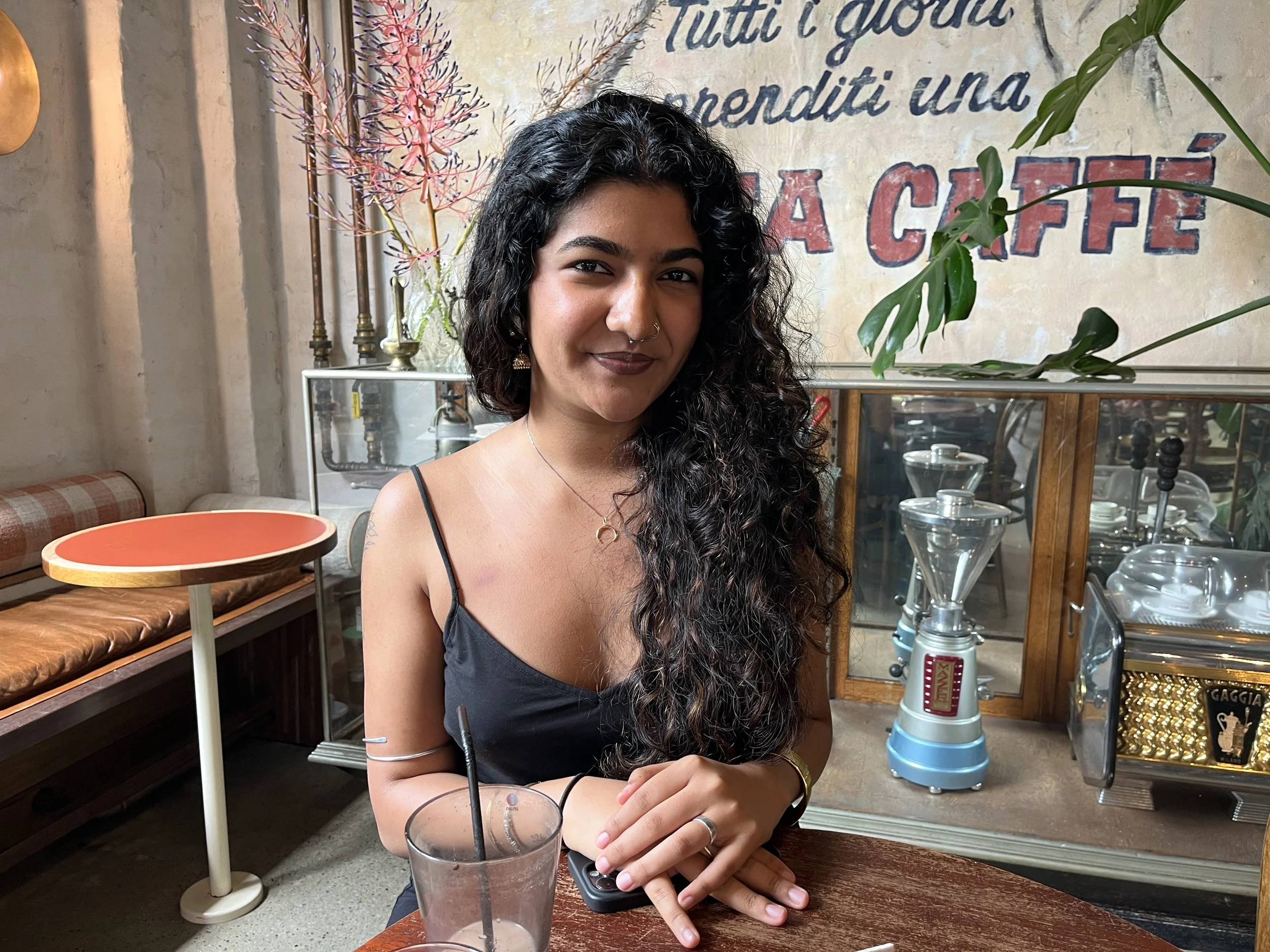
The Artist Currently Known As: Ananya Thirumalai
Ananya is a writer whose work you can find here. She’s also just launched The Diasporic Canon, a reading and discussion group centring works that write from and about the South Asian diaspora.
What are you studying? I’m doing a Bachelor of Arts and I’m in my third year. My majors are Digital Cultures and Business Law. Weird combination! It’s not what I actually want to study in the future—I’m hoping to do a Masters in teaching.
Could you tell me what you like to make? I’m a writer by heart. Right now I’m a journalist. I also have my first short story being published next year, which is exciting. Congratulations! Thank you! I’m hoping to delve more into that. It’s for USyd’s anthology series by the postgrad creative writing and publishing students. It’s a story about a girl who’s grown up outside of India and she’s being haunted by ancestors; very much religion, compulsory heterosexuality, all of that.I also draw, and I’m learning embroidery, and I’m learning dance.
What are you reading, watching, listening to, thinking about? I’m loving Addison Rae at the moment, I went to her concert. I think it’s the best concert I’ve been to! I was reading this book called The World We Found by Thrity Umrigar. Watching: one of my favourite shows, called Made in Heaven. It’s a mix of English and Hindi.
A through line that I’ve really connected to in your work is the politics of seeing and being seen as a lesbian. Is that something you’re interested in writing about quite intentionally?
Definitely. I feel like now, everyone expects you to fit into one box or another, and especially with lesbian culture, we forget to acknowledge our history. We forget our lesbian pioneers in fashion; we forget to acknowledge that trans people paved the way for us. My personal experience is that no-one ever guessed that I was a lesbian growing up. Looking at me, you wouldn’t be able to tell, unless maybe you were queer yourself. I felt like I was constantly having to prove myself. I feel finally at peace; I guess it helps that I’m in an openly queer relationship now, but I wish that it wasn’t necessary for people to see me for who I was.
I feel like too, modern queer culture is almost pretending to be ahistorical. Like that all the debates we’re having now, we’re having for the first time. Which of course is not true. But if you go into queer spaces it can feel really high stakes. I think it’s really hard to find queer spaces that are completely integrated with the political side of being queer, as well.
Last week we went to Birdcage, and there was someone holding a big cardboard sign with the BSB and account number of the Mob Strong Fund. On one side it said applause, and the other side was the BSB number; and people stopped clapping. The dj, who was awesome, was like, everyone get your fucking phones out! It was actually shocking the difference in audience reaction between, yay it’s all fun!, and then, we don’t want to think about other people’s struggles. Exactly.
The other thing I really connected with was in your great article, “Fluent in Honi.” There’s one line where you’re talking about how the publication can feel like “stumbling into a conversation where everyone else knows the punchline.” This is my first year at USyd, and even though I grew up in Sydney, as someone who was interested in student publications it sometimes felt like a bit of a secret language. What’s it been like for you navigating that as a writer?
It’s been really hard. I didn’t have to navigate it until I ran on a ticket for editorship, and then it was this information overload of trying to understand everything. I feel like that information could be made more accessible so people don’t have to scramble to find it. It’s a good thing we had two tickets this year [for Honi Soit]—that hasn’t happened since 2021. What do you mean, in a publication with hundreds of people contributing, there’s only ten people who want to edit? Surely there’s more, and they just don’t know how to do it. It’s just that the information is so confusing and student politics are so insular.
What’s your impression been of student politics on campus? Most people are really nice and welcoming, but some people have their priorities wrong; that might just be because of my own political alignments. Right now, they’re facing a lot of issues with the National Union of Students and Labour-backed student groups trying to exclude more activist groups from conversations. A lot of people just don’t understand why their student unions need to be activist spaces.
In that same article, you also wrote in reference to international students that “accessibility isn’t just about tone and jargon; it’s about where you go, who you talk to and how you show that someone’s story matters before they pitch it.” How has that experience played out for you (or not) on campus?
All outreach is done through social media, and there’s really diverging cultures with what social media international students use versus what social media people here use. I didn’t have Facebook until I got here and was trying to join clubs and societies. It also comes down to language; Honi has a multilingual category that I don’t think anyone has written an article in since—I might be wrong—May. I didn’t even know that. You’re just not going to get into that field unless you’re reaching out to people in different languages.
You can find Ananya @anyathirumalai.